RAG vs Traditional Chatbots: Which Approach Fits Your Business?
A chatbot can answer questions. The real question is whether it knows where the answer lives. Learn when scripted conversations work and when your business needs a RAG assistant.
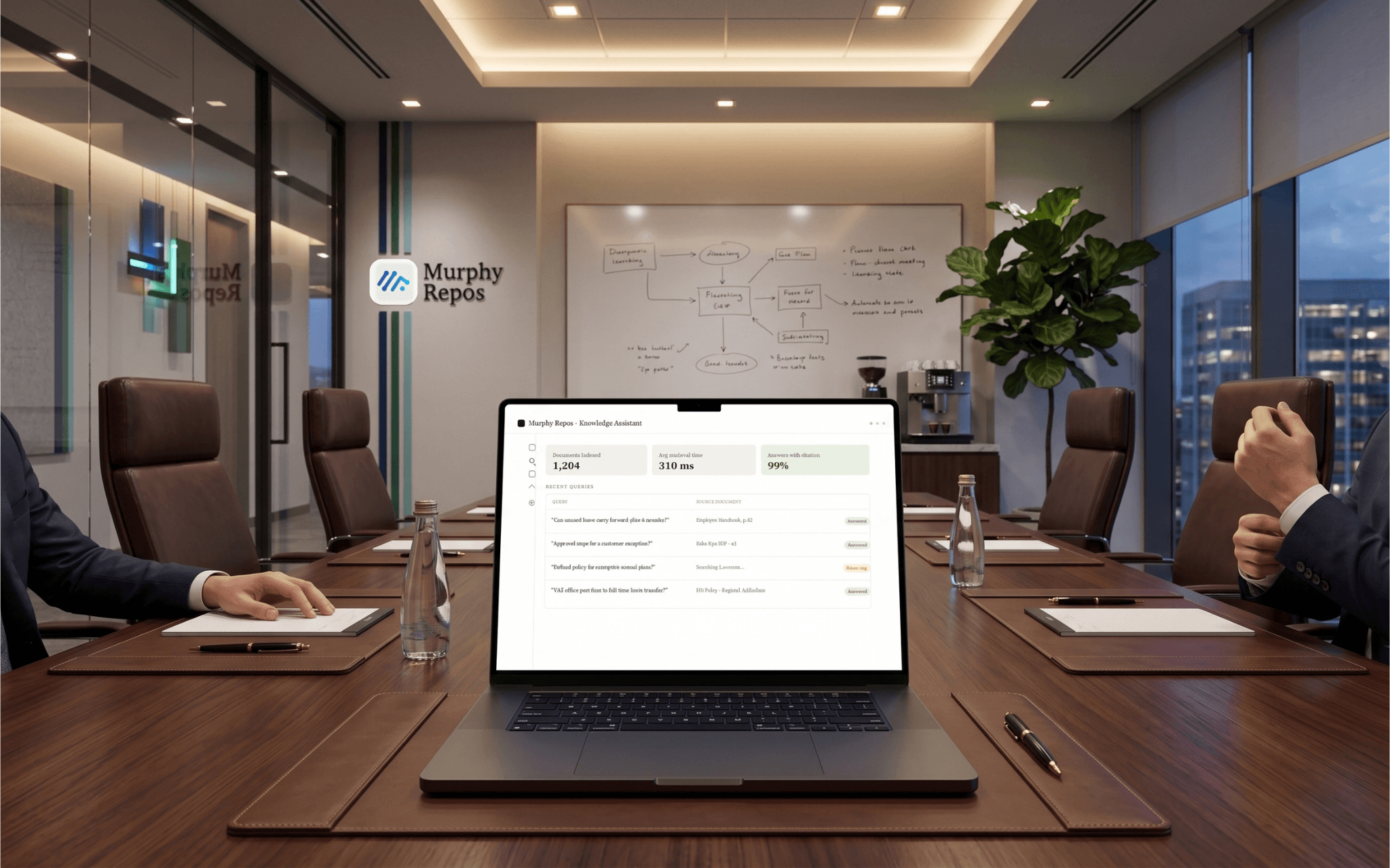
A chatbot can answer questions. The real question is whether it knows where the answer lives.
Most businesses can get a chatbot running in a matter of weeks. It handles the FAQ, walks a customer through a return, answers "what are your hours" without breaking a sweat. Then someone asks something that was never scripted, a question whose answer is real and sitting somewhere specific, buried in a policy document, a product manual, an internal wiki, a compliance PDF. The chatbot doesn't fail because it's dumb. It fails because nobody ever told it that document exists, let alone where in it the answer sits.
That's the actual line between a traditional chatbot and a RAG-based assistant, and it's not the line most marketing around this topic draws. It isn't "old technology versus new technology." It's the difference between a system built to hold a structured conversation and a system built to go find something it doesn't already know.
RAG stands for Retrieval-Augmented Generation. Instead of answering purely from a fixed script or whatever the underlying model happened to learn during training, a RAG system reaches out to an external knowledge source, pulls back whatever's actually relevant to the question being asked, and hands that to a language model as context before it writes the answer. IBM's own framing of this is useful: RAG connects a generative model to external knowledge sources so its responses can draw on information specific to your organization, not just whatever the model absorbed at training time.
So the question worth asking isn't "is RAG better than a chatbot." It's narrower and more useful than that: what does the person actually need the system to know, and where does that information currently live?
Where traditional chatbots work well
It's easy to talk about "traditional chatbots" like they're a legacy technology waiting to be replaced. They're not. Underneath, most of them run on some version of a state machine, intent matching, decision trees, sometimes a classification model like Rasa or Dialogflow deciding which pre-written branch a message belongs to. A customer says "what are your hours" and the system matches that to a fixed intent and returns a fixed answer. They say "I want to return an order" and the bot walks them through a defined sequence, order number, status check, return policy, next step.
None of that requires a knowledge-retrieval system, and building one for it would be solving a problem that doesn't exist. When interactions are genuinely predictable, booking a slot, checking a status, collecting a handful of form fields, a well-built traditional chatbot is fast, cheap to run, and, frankly, more reliable than a heavier architecture would be for the same job. We've watched teams reach for RAG on a problem that a decision tree would have solved in an afternoon, and it never ends up being worth the added complexity.
When scripted answers reach their limit
The trouble starts the moment a question depends on information too broad, too detailed, or too fluid to hand-code into a response tree.
Picture a company with a real document footprint, product manuals, HR policy, technical guides, onboarding material, compliance procedures, internal SOPs, the works. An employee asks something like: what's the approval process for this category of customer exception?
The answer exists. It's real, it's written down, it's probably even reasonably current. But finding it might mean opening three or four documents and reading until something matches. A traditional chatbot has no path to that answer, not because the question is unusual, but because the system was never given access to the company's actual knowledge, it was only ever given a fixed set of things it's allowed to say. This is exactly where RAG earns its place: not as a smarter version of the same thing, but as an architecture built for a fundamentally different problem, knowledge discovery instead of scripted conversation.
How retrieval augmented generation works
Strip away the acronym and RAG is two capabilities working together. First, the system retrieves relevant material from an external knowledge source. Then a generative model uses what it retrieved as grounding for the answer it writes. The flow, in its simplest form: a question comes in, the system searches for relevant information, that information becomes context, and only then does the model generate a response. AWS describes this as letting a model reference an authoritative knowledge base outside its own training data when it answers, the model isn't expected to already contain every fact about your business; it's expected to know how to look one up when asked.
That reframes what "the AI" actually has to be good at. It doesn't need to memorize your 70-page employee handbook. It needs to find the right three paragraphs in it when someone asks, say, whether unused annual leave carries forward after six months, search the relevant section, retrieve it, and use it as the basis for a written answer instead of generating something plausible-sounding from nothing. That distinction, grounded in a real document versus generated from general knowledge, is the entire value proposition, and it's also exactly where things go wrong when it's implemented carelessly.
What makes a RAG chatbot trustworthy
This is the part that gets skipped in most explanations, and it's the part that actually determines whether a RAG system is worth building. Adding retrieval to an AI assistant doesn't make it accurate by default. It makes it only as accurate as the material it's retrieving from, which means the real engineering work isn't the language model at all. It's everything underneath it.
Documents have to be broken into pieces small enough to retrieve precisely but large enough to keep their meaning, cut a policy mid-sentence and you can hand the model a technically-relevant, practically-useless fragment. Those pieces get converted into a mathematical representation (an embedding) so the system can search by meaning rather than exact keyword match, and the quality of that representation matters more in specialized domains, legal, medical, technical, than generic ones. Good implementations add a second pass that re-ranks what got retrieved, so noise gets filtered out before it ever reaches the model's context window. And the source documents themselves need active governance: outdated versions removed, contradictions resolved, freshness maintained as the underlying policies actually change. Skip any of that and you haven't built a smarter assistant, you've built a very articulate way of surfacing your worst documentation.
Two businesses can both describe what they have as "a RAG chatbot" and mean entirely different things. One has a maintained knowledge base with access controls, source citations, and a real retrieval-evaluation process behind it. The other uploaded a folder of PDFs and pointed a model at them. The label is identical. The architecture, and the trustworthiness of the answers, is not.
RAG vs traditional chatbots: match the interaction
The honest way to decide between these isn't "which is more advanced." It's "what shape is the interaction."
If someone is choosing a service, picking an appointment slot, providing an order number, or asking one of a small set of things that come up constantly, that's a structured interaction, a traditional chatbot handles it well and doesn't need retrieval to do so. RAG earns its place when someone needs to ask a genuine, open-ended, natural-language question against a body of knowledge too large or too specific to hand-script, a support case where the customer doesn't know which manual their problem lives in, so they just describe the symptom and expect the system to find the right section on its own.
Keeping business knowledge current
There's a second, quieter reason RAG matters for a lot of businesses: how often the underlying information changes. Update a return policy under a traditional chatbot setup, and someone has to go find the hardcoded response and edit it by hand. Update the same policy inside a RAG architecture, and the retrieval layer picks up the new version the next time the source document is re-indexed, no one has to touch the model, and in AWS's framing, that's the real architectural advantage of RAG: it decouples your knowledge from the model itself, so the model doesn't need retraining every time a policy changes underneath it. That doesn't mean the update is instant or automatic in every implementation, documents still need governance, old versions still need to be retired, and the system still needs testing after a meaningful change, but the burden shifts from "edit the bot" to "maintain the source of truth," which is a much healthier place for that burden to sit.
Design permissions into your AI knowledge assistant
The moment a knowledge base contains anything private, HR policy, compensation bands, internal technical documentation, retrieval and permissions have to be designed together, not bolted on afterward. An internal HR assistant shouldn't be able to surface a document meant for leadership just because the wording happens to match a query. A support assistant meant for customers should never have a path to internal engineering docs, no matter how relevant those docs might technically be to the question asked.
In practice, that means access control has to live at the retrieval layer itself, not just at the front door of the chat interface. Documents get tagged with who's allowed to see them during ingestion. Search results get filtered against the asking user's actual permissions before anything reaches the model. And ideally, every answer traces back to a specific source, the document, the section, sometimes the exact passage, so someone can audit what the assistant said and why. This is a big part of why a serious RAG project should be scoped and staffed like an information system, not treated as a slightly fancier chatbot build. The retrieval architecture and the access-control architecture are, in practice, the same project.
Knowledge retrieval and taking action are different jobs
There's one more distinction worth being precise about, because it's where a lot of RAG projects quietly overreach.
Ask "what's our refund policy" and a RAG system can retrieve the policy and explain it clearly. That's knowledge retrieval, and it's what RAG is built for. Ask instead "check this customer's order, confirm they qualify for a refund, update the CRM, and notify the account manager," and you've left knowledge retrieval behind entirely, that's a request to take action across systems, which needs tool access, business rules, and the ability to actually execute steps, not just explain them.
It's useful to think of this as a rough progression rather than four unrelated categories: a traditional chatbot runs a fixed conversation, RAG retrieves and explains knowledge, workflow automation executes predictable actions once a trigger fires, and agentic AI reasons across information and carries out multi-step tasks with some autonomy over the path it takes. Most businesses don't need the far end of that spectrum, and that's not a limitation, it's usually exactly right. The point of naming the progression isn't to push everyone toward the most sophisticated option. It's to make sure the option chosen actually matches the problem being solved, instead of being picked because it sounds more impressive in a pitch deck.
Which business AI chatbot fits your needs?
Start with the user, not the technology. What are they actually trying to accomplish? If it's a short list of predictable questions with fixed, defensible answers, a traditional chatbot is very likely the right, less expensive choice, and "less expensive" here isn't just cost, it's also lower operational risk, since there's no retrieval pipeline to maintain or govern. If people need natural-language access to a large or frequently changing body of company knowledge, and the real cost today is time spent hunting for answers that already exist somewhere, that's a real RAG use case. If the requirement goes further, the system needs to actually do something on someone's behalf, not just describe what should happen, automation or a more agentic architecture becomes the relevant conversation, and it's a different build with different risk considerations.
Choose the architecture after naming the problem
The instinct with AI projects is to reach for the most sophisticated architecture on offer, as if sophistication were the point. It isn't. A simple chatbot that reliably and cheaply handles a business's most common requests will outperform an elaborate AI system nobody quite trusts and "nobody trusts it" tends to be exactly what happens when a RAG system gets built on ungoverned documents with no thought given to citations or access control.
A RAG assistant earns its complexity when the actual problem is that people, employees or customers, can't find information that genuinely exists somewhere in the business. An agent earns its complexity when the problem goes past finding information and into taking action. Neither is a default. Both are a match to a specific, identifiable problem, and the fastest way to waste a real budget on this is to pick the architecture before you've actually named the problem.
So don't start with "should we use RAG." Start with what information the user actually needs. Then find out where that information currently lives, and how reliable it is. Only then does it make sense to ask what the system needs to do with it, retrieve it, explain it, or act on it. Answer those three in order and the technology choice mostly makes itself.
Murphy Repos builds RAG architectures, traditional chatbots, and the automation layers between them, matched to what the problem actually needs, not what sounds most advanced. If your team is losing time to information that already exists somewhere, book a consultation and we'll help you figure out which architecture actually fits.
Frequently asked questions
Have a project like this in mind?
Tell us where things stand and we will help you scope the fastest path to a working system.